Technique Guide
FUE vs DHI Hair Transplant: Which Method Is Right for You?
Key Takeaways
- FUE suits large areas and high graft counts; DHI excels at hairline design and maximum density.
- Both techniques leave only tiny micro-dot marks and produce permanent, natural results.
- The surgeon's skill and hairline planning matter far more than the technique label itself.
The two most widely used hair transplant methods today are FUE (Follicular Unit Extraction) and DHI (Direct Hair Implantation). Both produce permanent, natural results. But they work differently, suit different hair loss patterns, and have different recovery profiles. This article explains both honestly.
What Is FUE?
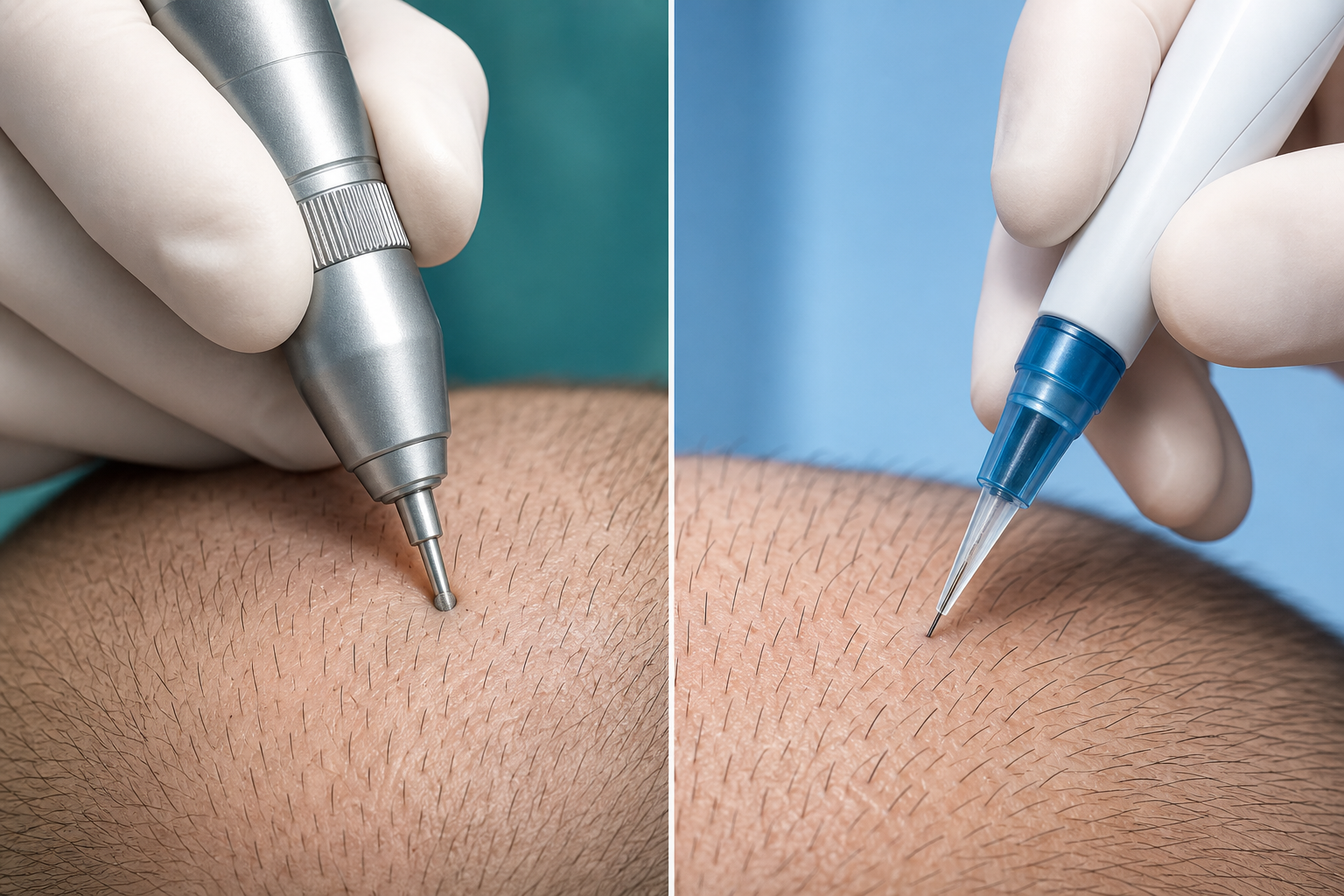
FUE — Follicular Unit Extraction — is currently the most performed hair transplant technique globally. Individual follicular units (groups of 1–4 hairs) are extracted from the donor area using a micro-punch device, then stored in a preservation solution while recipient channels are created. Finally, grafts are implanted into the channels.
The key characteristics of FUE:
- No linear scar — only micro-dot marks in the donor area, invisible with normal hair length
- Suitable for large sessions: 3,000–6,000+ grafts in a single sitting
- Recovery: return to desk work in 3–5 days, full physical activity in 2–3 weeks
- Versatile: scalp, beard, eyebrow, moustache transplants all possible
What Is DHI?
DHI — Direct Hair Implantation — uses a Choi implanter pen to extract and implant follicles simultaneously. Because no pre-made incisions are required, the surgeon has more precise control over the angle, direction and depth of each individual graft.
The key characteristics of DHI:
- Greater control over graft placement — angle and direction precisely set per follicle
- Less scalp trauma at the recipient site
- Faster healing in the recipient area compared to standard FUE
- Ideal for hairline design and high-density implantation
- Unshaved DHI option available for patients who prefer not to shave the donor area
FUE vs DHI: Head-to-Head Comparison
| Factor | FUE | DHI |
|---|---|---|
| Scar type | Micro-dot marks | Micro-dot marks |
| Graft control | Good | Very high — per-follicle precision |
| Best for | Large areas, high graft counts | Hairline, high density zones |
| Session graft limit | Up to 6,000+ | Up to 4,000 |
| Recovery (recipient) | 7–10 days redness | 5–7 days — less trauma |
| Shaving required | Yes | Optional (unshaved DHI available) |
| Cost | Standard | Slightly higher |
| Procedure duration | 6–8 hours | 7–9 hours |
Which Should You Choose?
The honest answer: it depends on your specific hair loss pattern and goals.
- Choose FUE if: you need a large graft count, have widespread thinning, or are on a tighter budget. FUE handles high-volume sessions better and is slightly less expensive.
- Choose DHI if: hairline precision is the priority, you want to add density to existing hair without shaving, or you prefer faster recipient-site healing.
- Many patients benefit from a combination: DHI for the hairline and temples, FUE for the crown and mid-scalp. This Hybrid approach is EsteCenter's most common recommendation for moderate-to-advanced hair loss.
At EsteCenter, our surgeons assess each patient individually and recommend the optimal technique — or combination — based on your donor density, recipient area size and natural hair characteristics. The recommendation comes with your free consultation at no charge.
What About Sapphire FUE?
Sapphire FUE is a refinement of standard FUE that uses synthetic sapphire blades (instead of steel) to create recipient channels. The finer, V-shaped incisions cause less scalp trauma, heal faster and allow denser implantation. At EsteCenter, Sapphire FUE is our standard — included in all FUE packages at no extra cost.
The Bottom Line
Both FUE and DHI are excellent, proven techniques. There is no single "better" method — only the method that's right for your individual case. The most important factor is not which technique is chosen, but the skill and experience of the surgeon performing it.